Ángel Di María is one of Argentina’s most accomplished footballers, celebrated for his extraordinary creativity, left-footed technique and ability to influence the biggest matches. Throughout his career, he has represented some of Europe’s most prestigious clubs, including Real Madrid, Manchester United, Paris Saint-Germain, Juventus and Benfica. His journey from a young footballer in Rosario to a FIFA World Cup champion is a remarkable story of talent, perseverance and determination.
Born on 14 February 1988 in Rosario, Argentina, Di María developed his footballing abilities at Rosario Central before moving to Europe in 2007. His career reached new heights at Real Madrid, where he played a crucial role in winning the 2013–14 UEFA Champions League. He subsequently enjoyed considerable success in France with Paris Saint-Germain and represented several other major European clubs.
However, his greatest achievements came while wearing Argentina’s national colours. He scored the winning goal in the 2021 Copa América final against Brazil, found the net in the 2022 FIFA World Cup final against France and helped Argentina defend its continental title at the 2024 Copa América.
After completing his second spell at Benfica and participating in the 2025 FIFA Club World Cup, Di María returned to Rosario Central. In June 2026, he extended his contract with the Argentine club until June 2027, continuing his professional career in the city where his football journey began.
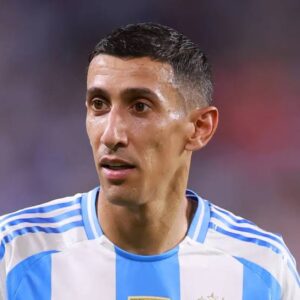
Ángel Di María Quick Facts
| Category | Details |
|—|—|
| Full Name | Ángel Fabián Di María |
| Date of Birth | 14 February 1988 |
| Age | 38 years (November 2026) |
| Birthplace | Rosario, Santa Fe, Argentina |
| Nationality | Argentine |
| Height | 1.78 m (5 ft 10 in) |
| Position | Winger / Attacking Midfielder |
| Preferred Foot | Left |
| Current Club | Rosario Central |
| Jersey Number | 11 |
| Former Clubs | Rosario Central, Benfica, Real Madrid, Manchester United, PSG, Juventus |
| National Team | Argentina (retired) |
| International Appearances | 145 |
| International Goals | 31 |
| Nickname | Fideo |
| Wife | Jorgelina Cardoso |
| Major Achievement | 2022 FIFA World Cup winner |
Early Life and Childhood
Ángel Di María was born on 14 February 1988 in Rosario, a football-loving city in Argentina’s Santa Fe Province. He grew up in a modest family with his parents and two sisters. His childhood was shaped by his family’s financial circumstances and his growing passion for football.
As a young boy, Di María showed considerable interest in playing football. He enjoyed spending time with a ball and gradually developed the technical skills that would later become central to his playing style.
At the age of seven, he joined Rosario Central’s youth academy. This was a significant turning point because it gave him access to organised coaching and competitive youth football.
His early development was not always easy. However, his determination and commitment helped him progress through the club’s youth system. Rather than giving up when faced with difficulties, he continued working towards his dream of becoming a professional footballer.
Youth Career and Breakthrough at Rosario Central
Rosario Central became the foundation of Di María’s professional development. He spent several years progressing through its youth teams, improving his movement, technical ability and understanding of the game.
His coaches recognised his attacking potential, particularly his pace and ability to create opportunities from wide positions. These qualities eventually helped him earn promotion to the senior squad.
On 14 December 2005, Di María made his first-team debut for Rosario Central at just 17 years old. His early appearances provided valuable experience in Argentine professional football.
He gradually established himself as a promising young attacking player. During his first spell at the club, he made 39 senior appearances and scored six goals.
Although his time in Argentina was relatively short, it was important for his development. His performances attracted attention from European clubs, and in 2007, Benfica offered him an opportunity to continue his career in Portugal.
Professional Football Career
Benfica: His First European Adventure (2007–2010)
In 2007, Ángel Di María moved from Rosario Central to Benfica, beginning his journey in European football. The Portuguese club recognised his potential and gave him an opportunity to develop in a more competitive environment.
Adjusting to European football required patience. Di María had to improve his tactical understanding, decision-making and ability to perform consistently against experienced defenders.
During his first seasons, he gradually became an important attacking option. His acceleration, dribbling and ability to deliver accurate passes made him particularly effective on the wings.
The 2009–10 campaign proved especially successful. Di María played an important role as Benfica won the Primeira Liga title and the Portuguese League Cup. His performances attracted attention from some of Europe’s biggest clubs.
In 2010, Real Madrid secured his signature. The transfer represented a major step forward, giving him the opportunity to compete alongside elite players and challenge for European football’s most prestigious trophies.
Real Madrid: The Champions League Breakthrough (2010–2014)
Di María joined Real Madrid in 2010 and quickly became an important part of the team’s attacking structure.
Under José Mourinho, he demonstrated that he was more than simply a fast winger. His ability to operate in different attacking positions, track back defensively and create opportunities made him a valuable member of the squad.
During the 2011–12 season, he helped Real Madrid win La Liga. The club also secured the Copa del Rey in 2011 and the Spanish Super Cup in 2012.
However, the defining period of his Madrid career arrived during the 2013–14 season.
Di María produced outstanding performances throughout the UEFA Champions League campaign. His movement, dribbling and creative passing helped Real Madrid reach the final against Atlético Madrid in Lisbon.
The final became one of the most memorable performances of his career. Di María repeatedly troubled Atlético’s defence, and his outstanding extra-time run past several opponents created the opportunity for Gareth Bale to score.
Real Madrid eventually won 4–1 after extra time, securing their tenth European Cup, famously known as La Décima.
Di María was named Man of the Match in the final, recognising his decisive contribution to the victory.
According to Real Madrid’s official historical records, he made 190 appearances and scored 36 goals during his four seasons at the club.
His achievements with Real Madrid included:
– UEFA Champions League: 2013–14
– La Liga: 2011–12
– Copa del Rey: 2010–11 and 2013–14
– UEFA Super Cup: 2014
– Spanish Super Cup: 2012
Despite his success, Di María left Real Madrid in August 2014 following the arrival of new attacking options and changes within the squad. Manchester United became his next destination.
Manchester United: A Difficult Premier League Experience (2014–2015)
In August 2014, Di María joined Manchester United in a high-profile transfer from Real Madrid. The English club invested heavily in the Argentine winger, hoping that his creativity and attacking quality would strengthen the team.
He made an encouraging start to life in the Premier League. His performances included impressive assists, dangerous attacking runs and a memorable chipped goal against Leicester City.
However, his season became increasingly difficult. Injuries, tactical adjustments and challenges adapting to English football affected his consistency.
Although he showed flashes of his quality, he could not reproduce the same level of influence that he had demonstrated in Spain.
After just one season at Manchester United, he moved to Paris Saint-Germain in 2015.
Paris Saint-Germain: A Successful Era in France (2015–2022)
Di María joined Paris Saint-Germain in August 2015, beginning one of the most successful periods of his club career.
The French side provided an environment where his creativity and attacking intelligence could flourish. He quickly became a key player, contributing goals, assists and intelligent movement in the final third.
During his seven seasons at PSG, he played alongside several outstanding footballers, including Neymar, Kylian Mbappé and Edinson Cavani.
His ability to create opportunities from wide positions made him an important part of the team’s attacking system. He also demonstrated his versatility by playing in different positions depending on the manager’s tactical requirements.
Di María helped PSG win five Ligue 1 titles, five Coupe de France trophies and four Coupe de la Ligue titles, along with multiple other domestic honours.
One of the biggest moments of his PSG career came during the 2019–20 UEFA Champions League campaign. The club reached its first Champions League final in history, facing Bayern Munich in Lisbon.
Although PSG lost 1–0, Di María played an important role in their journey to the final. His experience and creativity were valuable throughout the competition.
By the time he departed in 2022, he had become one of the most influential attacking players in PSG’s modern history.
Juventus: A New Challenge in Italy (2022–2023)
In July 2022, Di María joined Juventus on a free transfer after leaving Paris Saint-Germain.
His move to Serie A offered a new challenge and an opportunity to experience Italian football. Despite being in the later stages of his career, he continued to demonstrate his technical ability and creativity.
He scored important goals and contributed assists during the 2022–23 campaign. However, injuries and interruptions affected his availability throughout the season.
Juventus also experienced a difficult period off the pitch, including a points deduction in Serie A and the consequences of its financial investigation.
After one season in Turin, Di María decided to return to a club where he had previously enjoyed considerable success.
Benfica Return: Back to Familiar Surroundings (2023–2025)
In July 2023, Di María returned to Benfica, more than a decade after leaving Portugal for Real Madrid.
His return brought experience and quality to the Portuguese side. Having played for several of Europe’s biggest clubs, he was now an experienced footballer capable of influencing matches through intelligent movement, passing and finishing.
During his second spell, he continued to produce important attacking contributions in domestic competitions and European football.
He also helped Benfica compete for major honours, winning the Portuguese Super Cup in 2023 and the Portuguese League Cup in 2025.
His second spell at the club concluded in 2025. Before returning to Argentina, he represented Benfica at the FIFA Club World Cup, where the Portuguese side reached the knockout stages.
That tournament marked the end of his latest European chapter and the beginning of an emotional return to his hometown.
Return to Rosario Central in 2025
On 30 May 2025, Rosario Central officially announced that Ángel Di María would return to the club after completing his commitments with Benfica.
The announcement attracted considerable attention throughout Argentine football. After nearly 18 years in European football, the World Cup winner was preparing to wear the colours of his boyhood club once again.
He completed his participation in the 2025 FIFA Club World Cup with Benfica before returning to Argentina. He was subsequently presented as a Rosario Central player in July 2025.
For Di María, the move had a meaning that went beyond football. Rosario Central was where he had developed as a young player and made his professional debut.
His return also gave supporters the opportunity to watch one of Argentina’s most decorated footballers represent their club.
In June 2026, Rosario Central confirmed that Di María had extended his contract for another year, keeping him at the club until June 2027.
Ángel Di María’s Performance at Rosario Central in 2026
In 2026, Di María continues to play for Rosario Central, bringing his experience from Europe’s leading football competitions back to Argentine football.
He primarily operates in attacking positions, using his left foot, vision and movement to create opportunities for his teammates and score goals.
According to available league statistics updated after 31 October 2026, he had recorded:
– Appearances: 28
– Goals: 11
– Assists: 5
These figures refer specifically to the 2026 Argentine league campaign at that statistical snapshot, not his complete record across all competitions.
His performances demonstrate that he can still contribute at a high level despite being 38 years old. His return has also strengthened his connection with the supporters who followed his journey from the beginning.
International Career with Argentina
Ángel Di María’s international career is one of the most successful aspects of his football journey. He represented Argentina at major international competitions and became a decisive figure during the national team’s most successful modern period.
He made his senior international debut against Paraguay on 6 September 2008 in a FIFA World Cup qualifying match.
Before establishing himself in the senior national team, he had already achieved success at youth level. His international career eventually included a FIFA U-20 World Cup title, Olympic gold, two Copa América championships, a Finalissima victory and the FIFA World Cup.
His ability to produce important performances in major finals made him one of Argentina’s most valuable attacking players.
2007 FIFA U-20 World Cup
Di María was part of Argentina’s squad for the 2007 FIFA U-20 World Cup in Canada.
Argentina entered the competition with a talented group of young players and successfully won the tournament.
The experience provided Di María with valuable international exposure and helped him develop his confidence against some of the world’s most promising young footballers.
Winning the U-20 World Cup was one of his earliest international achievements and an important step towards his senior career.
2008 Beijing Olympic Games: Olympic Gold
Another major achievement came at the 2008 Beijing Olympic Games, where Di María represented Argentina’s Olympic football team.
Argentina progressed through the competition and reached the final against Nigeria.
The final was closely contested until Di María produced the decisive moment. He scored the only goal of the match with a delicate finish over the goalkeeper, securing a 1–0 victory.
The result gave Argentina the Olympic gold medal and established Di María as a player capable of delivering in important matches.
2014 FIFA World Cup: Reaching the Final
Di María played an important role in Argentina’s journey to the 2014 FIFA World Cup final in Brazil.
His speed and attacking movement helped the team create opportunities throughout the competition. One of his most important contributions came in the round-of-16 match against Switzerland.
With the match heading towards a penalty shootout, Di María scored the winning goal in extra time after receiving a pass from Lionel Messi.
Argentina progressed to the quarter-finals and eventually reached the final against Germany.
Unfortunately, Di María suffered a muscle injury during the tournament and missed the semi-final and final.
Argentina lost 1–0 to Germany after extra time. Although he could not participate in the final, his earlier contributions were an important part of the team’s campaign.
2021 Copa América: The Decisive Goal Against Brazil
The 2021 Copa América became one of the defining tournaments of Di María’s international career.
Argentina reached the final against Brazil at the Maracanã Stadium in Rio de Janeiro.
The match was intense, with both teams fighting for control. In the 22nd minute, Rodrigo De Paul delivered a long pass towards Di María, who controlled the ball and lifted it over goalkeeper Ederson.
His beautiful finish gave Argentina a 1–0 victory.
The result ended Argentina’s 28-year wait for a major senior international trophy and gave Lionel Messi his first major title with the national team.
For Di María, the goal was especially meaningful because it demonstrated his ability to make a difference in one of international football’s biggest matches.
2022 Finalissima: Another International Trophy
On 1 June 2022, Argentina faced Italy in the Finalissima at Wembley Stadium in London.
The match brought together the champions of South America and Europe.
Di María scored Argentina’s second goal with an excellent finish during the first half. Argentina eventually won 3–0, adding another trophy to the team’s growing collection.
His performance continued a remarkable period in which he repeatedly delivered in important international matches.
2022 FIFA World Cup: The Night Argentina Became Champions
The 2022 FIFA World Cup in Qatar delivered the greatest achievement of Di María’s career.
Argentina entered the competition with high expectations but suffered an unexpected 2–1 defeat against Saudi Arabia in their opening match.
The team recovered from that setback and gradually improved throughout the tournament, eventually reaching the final against France.
The final on 18 December 2022 at Lusail Stadium became one of the greatest matches in World Cup history.
Di María started the match and produced an outstanding performance. He won the penalty that Lionel Messi converted for Argentina’s opening goal and later scored the team’s second goal after a brilliant attacking move.
His goal extended Argentina’s advantage to 2–0 and put the team in a strong position.
France fought back through Kylian Mbappé, and the match eventually finished 3–3 after extra time.
Argentina won the penalty shootout 4–2, securing its third FIFA World Cup title.
Di María’s contribution to the final was particularly important. He had now scored in the finals of the 2008 Olympics, 2021 Copa América and 2022 FIFA World Cup.
Winning the World Cup completed an extraordinary international journey that began with his early appearances for Argentina’s youth teams.
2024 Copa América: A Fitting International Farewell
The 2024 Copa América in the United States became Di María’s final major tournament with Argentina.
Before the competition, he had announced that he intended to retire from international football after the tournament.
Argentina performed strongly throughout the competition and reached the final against Colombia.
The final took place on 14 July 2024 at Hard Rock Stadium in Miami Gardens. After a closely contested match, Lautaro Martínez scored the winning goal in extra time.
Argentina secured a 1–0 victory and successfully defended its Copa América title.
Di María started the final and played an important role before being substituted late in the match.
The victory gave him his second Copa América championship and a memorable conclusion to his international career.
He finished his Argentina career with 145 appearances and 31 goals. He also recorded 32 assists according to CONMEBOL’s historical statistics.
Why Ángel Di María Retired from International Football
Di María’s decision to retire from international football was closely connected to his desire to end his Argentina career after achieving its biggest possible honours.
He had experienced the disappointment of losing major finals, including the 2014 World Cup and earlier Copa América tournaments.
However, the victories in 2021, 2022 and 2024 transformed his international legacy.
By retiring after the 2024 Copa América, he was able to finish his Argentina journey as a two-time continental champion and World Cup winner.
Although he no longer represents the national team, his influence on Argentina’s recent success remains significant.
Playing Style and Football Strengths
Ángel Di María is recognised for his combination of technical skill, creativity, speed and tactical versatility. Throughout his career, he has played as a right winger, left winger, attacking midfielder and occasionally in more central attacking roles.
Although his preferred foot is his left, he has developed the ability to create opportunities from different areas of the pitch.
His most important footballing strengths include:
**Dribbling and Ball Control:** Di María is particularly effective in one-on-one situations. His close control and quick changes of direction allow him to move past defenders.
**Pace and Acceleration:** His speed helps him exploit open spaces, launch counter-attacks and create problems for opposing defences.
**Passing and Vision:** One of his greatest qualities is his ability to recognise attacking opportunities and deliver accurate through balls, crosses and passes.
**Left-Footed Technique:** His left foot allows him to produce dangerous crosses, long-range shots and technically difficult finishes.
**Creativity:** He can create scoring opportunities even when attacking spaces are limited, making him valuable against organised defensive teams.
**Versatility:** He has played in multiple attacking positions and adapted to different tactical systems throughout his career.
**Big-Match Performance:** His goals in the 2021 Copa América final and 2022 World Cup final demonstrate his ability to perform under pressure.
Ángel Di María Trophies and Major Achievements
Di María has won numerous domestic, European and international trophies throughout his professional career.
Club Honours
**Benfica**
– Primeira Liga: 2009–10
– Taça da Liga: 2008–09, 2009–10
– Portuguese Super Cup: 2023
– Portuguese League Cup: 2025
**Real Madrid**
– UEFA Champions League: 2013–14
– La Liga: 2011–12
– Copa del Rey: 2010–11, 2013–14
– UEFA Super Cup: 2014
– Spanish Super Cup: 2012
**Paris Saint-Germain**
– Ligue 1: Five titles
– Coupe de France: Five titles
– Coupe de la Ligue: Four titles
– Trophée des Champions: Multiple titles
**Manchester United**
– No major team trophy during his 2014–15 spell.
**Juventus**
– No major team trophy during his 2022–23 spell.
International Honours with Argentina
– FIFA U-20 World Cup: 2007
– Olympic Gold Medal: 2008
– Copa América: 2021
– Finalissima: 2022
– FIFA World Cup: 2022
– Copa América: 2024
Notable Individual Achievements
– UEFA Champions League Final Man of the Match: 2014
– Scored the winning goal in the 2008 Olympic football final
– Scored the winning goal in the 2021 Copa América final
– Scored in the 2022 FIFA World Cup final
– One of Argentina’s most experienced international players, with 145 senior appearances
His trophy collection reflects his success across different leagues and his importance to Argentina’s national team.
Ángel Di María Personal Life and Family
Ángel Di María is married to Jorgelina Cardoso. The couple have two daughters and have maintained a relatively private family life despite his international fame.
His wife has been an important source of support throughout his professional career. Moving between different countries and football cultures required considerable adjustments, and his family accompanied him through many of these experiences.
Di María has frequently spoken about his emotional connection to Rosario and the importance of his family. His decision to return to Rosario Central in 2025 allowed him to reconnect with his hometown and continue his career closer to home.
Away from football, he generally maintains a private lifestyle and avoids unnecessary public attention.
Ángel Di María Net Worth, Salary and Lifestyle
Ángel Di María has earned substantial income through his professional football career, which has included contracts with some of Europe’s wealthiest clubs.
His time at Real Madrid, Manchester United, Paris Saint-Germain, Juventus and Benfica contributed significantly to his career earnings. He has also benefited from commercial partnerships and sponsorship opportunities.
However, his exact net worth in November 2026 has not been confirmed through a reliable public financial disclosure. Online celebrity wealth estimates should therefore be treated cautiously rather than presented as verified figures.
His lifestyle and financial position reflect a long career at the highest level of professional football, although precise details of his private finances are not publicly established.
Frequently Asked Questions About Ángel Di María
1. Who is Ángel Di María?
Ángel Di María is an Argentine professional footballer who plays for Rosario Central. He is widely recognised for his successful career at Real Madrid, Manchester United, Paris Saint-Germain, Benfica and the Argentina national team.
2. How old is Ángel Di María in 2026?
He was born on 14 February 1988 and is 38 years old as of November 2026.
3. Which club does Ángel Di María play for in 2026?
He plays for Rosario Central in Argentina. He returned to the club in 2025 and extended his contract in June 2026 until June 2027.
4. What position does Ángel Di María play?
He primarily plays as a winger but can also operate as an attacking midfielder. His preferred foot is his left.
5. Did Ángel Di María win the FIFA World Cup?
Yes. He won the 2022 FIFA World Cup with Argentina in Qatar and scored a goal in the final against France.
6. How many goals did Di María score for Argentina?
He scored 31 goals in 145 senior international appearances for Argentina.
7. Why is Ángel Di María called Fideo?
Fideo is a Spanish word meaning noodle. It became his well-known nickname because of his slim physical appearance during his younger years.
8. Did Di María win the UEFA Champions League?
Yes. He won the 2013–14 UEFA Champions League with Real Madrid and was named Man of the Match in the final against Atlético Madrid.
9. When did Ángel Di María retire from international football?
He concluded his Argentina career after the 2024 Copa América final on 14 July 2024, when Argentina defeated Colombia 1–0.
10. How many Copa América titles did Di María win?
He won two Copa América titles with Argentina, in 2021 and 2024.
11. Did Ángel Di María play for Manchester United?
Yes. He joined Manchester United from Real Madrid in August 2014 and spent one season at the English club before moving to Paris Saint-Germain in 2015.
12. How many goals did Di María score in the 2022 World Cup final?
He scored one goal against France, Argentina’s second goal of the match. He also won the penalty that Lionel Messi converted for the opening goal.
Conclusion
Ángel Di María’s football journey is an example of how talent, persistence and determination can lead to extraordinary achievements. From his early development at Rosario Central to his success with Real Madrid and Paris Saint-Germain, he has built a career that places him among Argentina’s most accomplished modern footballers.
His achievements extend far beyond club football. Winning the 2021 Copa América, the 2022 FIFA World Cup and the 2024 Copa América established his place in one of the greatest periods in Argentina’s football history.
His goals in the finals against Brazil and France will remain defining moments of his international career. They also demonstrate why he became known as a player who could deliver when the pressure was highest.
After retiring from international football in 2024, Di María returned to Rosario Central in 2025 and renewed his contract in 2026. His story has therefore come full circle, bringing him back to the club where his professional journey began.
For football supporters, Ángel Di María will be remembered not only for the trophies he won but also for his creativity, decisive performances and contribution to Argentina’s historic success.
Discover the inspiring lives, remarkable careers, achievements, and personal journeys of more iconic stars. Read Full Biography