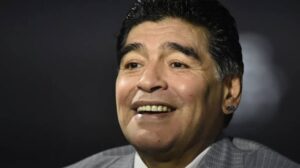
Diego Maradona was one of the most gifted and influential footballers in history. Known for his extraordinary dribbling, incredible left foot, creativity, and fearless playing style, he inspired millions of fans around the world. His unforgettable performances for Argentina and Napoli made him a global football icon.
From growing up in a poor neighbourhood in Argentina to lifting the FIFA World Cup trophy in 1986, Maradona lived a remarkable life filled with sporting success, personal challenges, and unforgettable moments. Even after his death in 2020, his name remains deeply connected to the history of football.
This is the complete story of Diego Maradona’s early life, family, football career, achievements, personal struggles, and lasting legacy, updated for 2026.
Early Life and Childhood
Diego Armando Maradona was born on October 30, 1960, in Lanús, Buenos Aires Province, Argentina. He grew up in Villa Fiorito, a working-class neighbourhood on the outskirts of Buenos Aires.
His family faced financial difficulties, and life was not always easy. His father, Diego Maradona Senior, worked hard to support the family, while his mother, Dalma Salvadora Franco, lovingly cared for their children.
Maradona developed a passion for football at a very young age. A football was one of his favourite possessions, and he spent countless hours playing with friends in the streets and local neighbourhoods.
His natural ability quickly became noticeable. Even as a child, he could control the ball exceptionally well, move past opponents with ease, and create opportunities that other young players could hardly imagine.
When he was around ten years old, Maradona joined the youth setup of Argentinos Juniors. His performances attracted attention, and he became part of a talented youth team known as Los Cebollitas.
His childhood was the beginning of a journey that would eventually change Argentine football forever.
Family Background
Maradona came from a close-knit family. His parents played important roles in his upbringing, and he often spoke about the sacrifices they made to support him.
His father, Diego Maradona Senior, was widely known as Don Diego, while his mother was affectionately called Doña Tota.
Maradona was one of eight children. His family remained an important part of his life, even after he became an international football superstar.
His rise from a modest background to worldwide fame became an inspiration for many young footballers, particularly those who grew up with limited opportunities.
Beginning of His Professional Football Career
Maradona’s professional career began with Argentinos Juniors. On October 20, 1976, he made his first-team debut against Talleres de Córdoba, just ten days before his 16th birthday.
His performances quickly attracted attention throughout Argentina. He was remarkably young, but his confidence, technique, and ability to control matches made him stand out.
During his time at Argentinos Juniors, Maradona developed into one of the country’s most exciting young footballers. His performances earned him a place in the Argentina national team and opened the door to a bigger career.
In 1981, he moved to Boca Juniors, one of Argentina’s most popular football clubs.
Boca Juniors: Becoming a National Superstar
Maradona joined Boca Juniors in 1981. The transfer was a major moment in Argentine football because he was already one of the country’s most celebrated young players.
He quickly became a favourite among Boca supporters. His attacking creativity, powerful shots, and ability to change a match made him one of the team’s most important players.
During his first spell at Boca Juniors, he helped the club win the 1981 Argentine Metropolitano Championship.
His performances increased his popularity and helped establish him as a national football hero.
In 1982, Maradona moved to Europe to begin a new chapter in his career.
Barcelona Career: His First European Challenge
In 1982, Maradona signed for FC Barcelona in Spain. The transfer attracted worldwide attention because Barcelona had secured one of the most talented footballers of his generation.
His time at the Spanish club included moments of brilliance as well as serious difficulties. He displayed his extraordinary technique and attacking quality, but injuries and health problems affected his progress.
In 1983, he suffered a serious ankle injury after a challenge from Athletic Bilbao defender Andoni Goikoetxea. The injury kept him out of action for a significant period.
Despite the challenges, Maradona helped Barcelona win several trophies, including:
– Copa del Rey (1982–83)
– Copa de la Liga (1982–83)
– Spanish Super Cup (1983)
Maradona left Barcelona in 1984. Although his spell in Spain was not as successful as many had hoped, it played an important role in his development as a footballer.
His next destination would become the most defining club chapter of his career.
Napoli Career: The Greatest Chapter of His Club Football Journey
In 1984, Maradona joined Napoli in Italy. At the time, the club was not considered one of the dominant forces in Italian football.
His arrival transformed the team’s ambitions and gave supporters hope of achieving something special.
Maradona quickly became the centre of Napoli’s attack. His incredible close control, passing, vision, and ability to score important goals made him one of the most influential players in Serie A.
He helped Napoli win their first-ever Italian league title in the 1986–87 season. It was a historic achievement for the club and its supporters.
Napoli also won the Coppa Italia during the same season.
His major achievements with Napoli included:
– Serie A: 1986–87
– Coppa Italia: 1986–87
– UEFA Cup: 1988–89
– Serie A: 1989–90
– Italian Super Cup: 1990
The 1989 UEFA Cup triumph was another major highlight. Napoli defeated VfB Stuttgart over two legs in the final, with Maradona playing a central role in the team’s success.
During his time in Naples, Maradona became more than a footballer. He became a symbol of pride and identity for the city.
Supporters admired him because he helped Napoli compete against Italy’s strongest clubs and brought historic success to the team.
His connection with the city remains so important that Napoli’s stadium was renamed the Stadio Diego Armando Maradona in his honour in 2020.
Later Club Career: Sevilla, Newell’s Old Boys and Boca Juniors
After leaving Napoli in 1991, Maradona continued his football journey with other clubs.
Sevilla
In 1992, he joined Sevilla in Spain. His return to Spanish football attracted considerable attention, and he played in La Liga during the 1992–93 season.
Although his spell was relatively short, it represented another chapter in his international club career.
Newell’s Old Boys
In 1993, Maradona returned to Argentina and joined Newell’s Old Boys.
His arrival generated excitement among supporters, although his time at the club was brief.
Final Return to Boca Juniors
In 1995, Maradona returned to Boca Juniors. It was an emotional return for the player and the club’s supporters.
He continued playing until 1997, when he officially retired from professional football.
His career had taken him from the streets of Villa Fiorito to some of the biggest stadiums in the world.
Maradona’s international career was one of the most memorable parts of his football journey.
He made his senior debut for Argentina in 1977 and went on to represent his country in four FIFA World Cup tournaments:
– 1982 FIFA World Cup in Spain
– 1986 FIFA World Cup in Mexico
– 1990 FIFA World Cup in Italy
– 1994 FIFA World Cup in the United States
According to the Argentine Football Association, Maradona scored 34 goals in 91 appearances for the senior national team.
His greatest international achievement came in 1986, when he captained Argentina to the FIFA World Cup title.
The 1986 FIFA World Cup in Mexico became the defining moment of Maradona’s international career.
Argentina entered the tournament with a talented squad, but Maradona’s performances made the team especially dangerous.
As captain, he inspired his teammates with his leadership, creativity, and extraordinary ability on the ball.
He scored five goals during the tournament and played a decisive role in Argentina’s journey to the final.
One of the most famous matches took place on June 22, 1986, when Argentina faced England in the quarter-finals.
Maradona scored two goals that became part of football history.
The Hand of God Goal
The first goal became known as the “Hand of God.”
Maradona challenged England goalkeeper Peter Shilton for the ball and used his left hand to send it into the net. The referee allowed the goal to stand, and it immediately became one of the most controversial moments in World Cup history.
Maradona later famously described it as being scored partly with his head and partly with the hand of God.
The Goal of the Century
Just minutes later, Maradona produced an extraordinary individual goal.
He collected the ball inside his own half, moved past several England players, entered the penalty area, and finished beyond goalkeeper Peter Shilton.
The goal demonstrated his remarkable balance, acceleration, close control, and dribbling ability.
It later became known as the “Goal of the Century” after being voted FIFA World Cup Goal of the Century.
The team then faced West Germany in the final on June 29, 1986, at the Estadio Azteca in Mexico City.
Argentina took a 2–0 lead through goals from José Luis Brown and Jorge Valdano. West Germany fought back to make the score 2–2.
In the 84th minute, Maradona delivered a brilliant pass to Jorge Burruchaga, who scored the winning goal.
Argentina won the final 3–2 and lifted its second FIFA World Cup trophy.
Maradona received the Golden Ball as the tournament’s best player.
His performances in Mexico made him a worldwide football legend.
1990 FIFA World Cup: Another Final Appearance
Maradona returned to the World Cup in 1990 as Argentina’s captain and defending champion.
The tournament was more difficult than the previous one. Argentina struggled in some matches but reached the final after defeating Italy in a dramatic semi-final decided by a penalty shootout.
In the final, Argentina faced West Germany once again.
This time, West Germany won 1–0 through Andreas Brehme’s late penalty.
Argentina finished as runners-up, while Maradona came close to winning a second consecutive World Cup.
Although he did not lift the trophy, his leadership and determination remained important parts of Argentina’s campaign.
1994 FIFA World Cup and the End of His International Career
Maradona played in the 1994 FIFA World Cup in the United States.
He scored a memorable goal against Greece, but his tournament ended after he tested positive for a banned substance, ephedrine, and was removed from the competition.
The incident became one of the most difficult moments of his career.
He never played another match for Argentina after the 1994 World Cup.
Despite the controversy, his contribution to Argentine football remained extraordinary.
Maradona was famous for his incredible technical ability and creative approach to football.
Although he was relatively short compared with many professional players, his low centre of gravity helped him maintain balance while dribbling at speed.
His greatest strengths included:
– **Dribbling:** He could move past multiple defenders in tight spaces.
– **Ball Control:** His close control made it difficult for opponents to take the ball away.
– **Vision:** He regularly found passing opportunities that other players could not see.
– **Creativity:** He could create chances from seemingly impossible situations.
– **Left Foot:** His powerful and accurate left foot was one of his greatest weapons.
– **Leadership:** He inspired teammates and often carried responsibility during important matches.
– **Free Kicks:** He was also highly skilled at taking direct free kicks and set pieces.
Maradona was not simply a goalscorer. He was a complete attacking creator who could influence almost every part of a match.
Maradona collected several major trophies and individual honours throughout his career.
Major Team Honours
| Competition | Achievement |
|—|—|
| FIFA World Cup | Winner, 1986 |
| FIFA World Cup | Runner-up, 1990 |
| FIFA World Youth Championship | Winner, 1979 |
| Argentine Metropolitano | Winner, 1981 |
| Serie A | Winner, 1986–87 and 1989–90 |
| Coppa Italia | Winner, 1986–87 |
| UEFA Cup | Winner, 1988–89 |
| Italian Super Cup | Winner, 1990 |
| Copa del Rey | Winner, 1982–83 |
| Spanish League Cup | Winner, 1982–83 |
| Spanish Super Cup | Winner, 1983 |
Major Individual Awards
– FIFA World Cup Golden Ball: 1986
– FIFA World Youth Championship Golden Ball: 1979
– FIFA World Cup Goal of the Century: 1986
– South American Footballer of the Year: 1979 and 1980
– Argentine Footballer of the Year: Multiple times
– FIFA 100: Included in the list of the world’s greatest living players in 2004
After retiring as a player, Maradona continued working in football as a manager.
He coached several teams, including clubs in Argentina and other countries. His most high-profile managerial appointment came in 2008, when he became head coach of the Argentina national team.
He guided Argentina to the 2010 FIFA World Cup in South Africa.
Argentina reached the quarter-finals but lost 4–0 to Germany. Maradona left the national team position later that year.
Although his managerial career did not reach the same heights as his playing career, he remained a major personality in international football.
Personal Life and Relationships
Maradona’s personal life often attracted media attention.
He married Claudia Villafañe in 1989. The couple had two daughters, Dalma and Gianinna. Their relationship later ended, and they separated.
Maradona also publicly acknowledged other children during his lifetime.
Away from football, he was known for his strong personality, emotional connection with supporters, and complicated relationship with fame.
His life included personal struggles that sometimes overshadowed his sporting achievements. Nevertheless, his footballing talent continued to inspire generations.
Diego Maradona Net Worth
Diego Maradona earned money through professional football contracts, sponsorships, public appearances, and other commercial activities during his lifetime.
However, his exact net worth at the time of his death has not been reliably established through a single verified public financial statement.
Different online sources have published different estimates, but these figures should not be treated as confirmed facts.
His lasting value to football cannot be measured by money alone. His influence on Argentina, Napoli, and football supporters around the world remains far more significant than any financial estimate.
Death and Legacy
Diego Maradona died on November 25, 2020, at the age of 60. His death followed a period of medical complications after brain surgery.
His passing shocked the football world. Fans, players, clubs, and national teams paid tribute to one of the sport’s most influential figures.
Argentina declared national mourning, while supporters gathered to remember his extraordinary career.
In Naples, where he had achieved historic success with Napoli, his memory remains especially powerful. The club’s stadium was renamed Stadio Diego Armando Maradona in December 2020.
In 2026, football fans continue to remember him. The year marks 40 years since his unforgettable performance at the 1986 FIFA World Cup, when he led Argentina to its second world title.
Maradona’s legacy is not only about trophies and statistics. It is also about the joy, excitement, and emotion he brought to millions of people through football.
Interesting Facts About Diego Maradona
1. Maradona made his professional debut before his 16th birthday.
2. He was nicknamed “El Pibe de Oro,” meaning “The Golden Boy.”
3. He won the 1979 FIFA World Youth Championship with Argentina.
4. He captained Argentina to the 1986 FIFA World Cup title.
5. He scored five goals at the 1986 World Cup.
6. His solo goal against England became known as the “Goal of the Century.”
7. He helped Napoli win two Serie A titles.
8. He won the UEFA Cup with Napoli in 1989.
9. He represented Argentina at four FIFA World Cups.
10. Napoli renamed its stadium in his honour after his death.
Frequently Asked Questions About Diego Maradona
1. Who was Diego Maradona?
Diego Maradona was an Argentine professional footballer and manager widely regarded as one of the greatest players in football history. He was famous for his dribbling, creativity, and leadership.
2. When was Diego Maradona born?
He was born on October 30, 1960, in Lanús, Buenos Aires Province, Argentina.
3. When did Diego Maradona die?
Maradona died on November 25, 2020, at the age of 60.
4. How many World Cups did Diego Maradona win?
He won one FIFA World Cup as a player, in 1986 with Argentina. He also reached the final in 1990.
5. Which club made Diego Maradona most famous?
He played for several famous clubs, but his time at Napoli is often considered the most defining chapter of his club career.
6. How many goals did Maradona score for Argentina?
According to the Argentine Football Association, he scored 34 goals in 91 senior international appearances.
7. What was Diego Maradona’s nickname?
His most famous nickname was “El Pibe de Oro,” which means “The Golden Boy.”
8. What was the Hand of God goal?
It was Maradona’s controversial first goal against England in the 1986 World Cup quarter-final. He used his hand to direct the ball into the net, but the referee allowed the goal.
9. What was Maradona’s most famous goal?
His second goal against England in the 1986 World Cup quarter-final is widely known as the “Goal of the Century.” He dribbled past several opponents before scoring.
10. Why is Diego Maradona remembered in 2026?
Maradona remains one of football’s most influential legends. In 2026, the football world marks the 40th anniversary of his extraordinary 1986 World Cup triumph with Argentina.
Conclusion
Diego Maradona’s life was a remarkable journey from a modest childhood in Argentina to worldwide football fame. His extraordinary talent, unforgettable performances, and leadership made him one of the most influential players the sport has ever seen.
His achievements with Argentina, especially the 1986 FIFA World Cup victory, and his historic success with Napoli secured his place in football history.
Although his life included personal struggles and controversy, his contribution to the beautiful game remains unforgettable.
Diego Maradona was more than a footballer. He was a symbol of passion, creativity, and the power of football to inspire people across generations. His name will always be remembered as one of the greatest in the history of the sport.
Discover the inspiring lives, remarkable careers, achievements, and personal journeys of more iconic stars. Read Full Biography